Dataverse
Description
'Dataverse' is an open source (code is available on GitHub) web application to share, preserve, cite, explore and analyze research data. It facilitates making data available to others, and allows you to replicate others' work (see their About page). Researchers, data authors, publishers, data distributors, and affiliated institutions all receive appropriate credit via a data citation with a persistent identifier (DOI, or Handle).
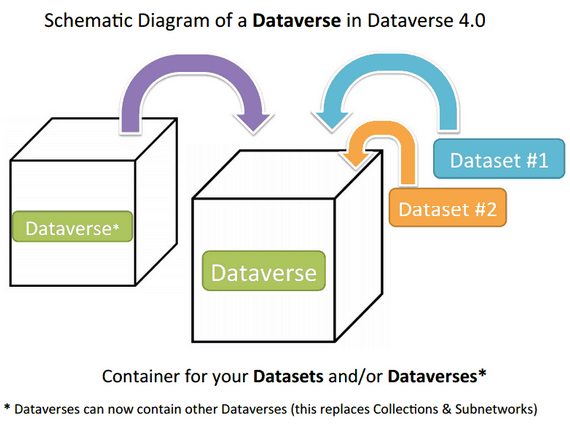
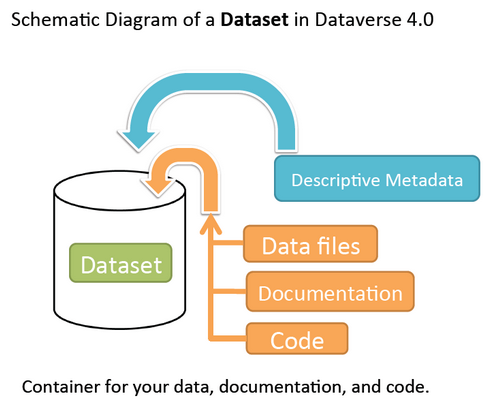
A Dataverse repository hosts multiple dataverses (see diagram). Each dataverse contains dataset(s) or other dataverses, and each dataset contains descriptive metadata and data files (including documentation and code that accompany the data - see diagram).
Provider
Institute for Quantitative Social Science at Harvard University, along with many collaborators and contributors worldwide.
Licensing and cost
Apache 2 License – free.
Platform and interoperability
The Dataverse makes use of the following components: Java Server Faces; Enterprise Java Beans; PostgreSQL; Solr; and R and Zelig. Prerequisites for installation include Oracle JDK or OpenJDK, a “virgin” installation of Glassfish Version 4.1+, preferably as part of the NetBeans Web Development bundle, PostgreSQL Version 9.3+, and R. The software was designed to integrate reCAPTCHA, Google Analystics, ImageMagick, Shibboleth, and DOI registration via EZID if the installer so wishes. The Dataverse currently has multiple open APIs available, which allow for searching, depositing and accessing data.
Functional notes
Dataverses can be configured for multiple levels of access (at the dataverse, dataset and file level). Dataverse will accept any format, but will give full support to tabular data or fits file data (astronomy format). SPSS, STATA, R and csv are the preferred formats; data in these formats will be eligible for subsettable features, multiple formats for download, and a Universal Numerical Fingerprint (UNF). These files will be eligible for subsetting and pre-defined measurements. Dataverse has the capability to register DOIs from EZID, which allows the repository to assign persistent identifiers to data sets.
Documentation and user support
The website contains extensive software documentation, including user, installer, and developer guides. A Users google group appears to be reasonably active, along with a specific support email address.
Usability
The Dataverse software provides a web-based interface for both administrators and users. The package includes an installer, which is run through the command line; basic install is designed to be very quick. Comfort with command-line interface and general systems knowledge appear to be crucial for configuration and installation of any add-ons.
Expertise required
To take full advantage of the archival management features in the software, users should have a firm grasp on the metadata expectations for their field.
Standards compliance
The software supports numerous metadata standards, including DDI, Dublin Core, Data Cite, Virtual Observatory (for astronomy), ISA-Tab (for biomedical). Each dataset is also given a data citation with a persistent global unique identifier that is in compliance with DataCite and the Joint Declaration of Data Citation Principles.
Influence and take-up
Current installations include
- Harvard University: A collaboration with the Institute for Quantitative Social Science (IQSS), the Harvard Library, and Harvard University Information Technology (HUIT): the Harvard Dataverse is a repository for sharing, citing, analyzing, and preserving research data; open to all scientific data from all disciplines worldwide.
- Odum Institute
- Dutch Universities (DANS)
- Fudan University
- University of Alberta Libraries
- Department of Cross Cultural and Regional Studies, University of Copenhagen (ToRS)
- ABACUS - British Columbia Research Libraries' Data Services
- Scholars Portal - Ontario Council of University Libraries (OCUL)
- HeiDATA - Heidelberg University
- UiT Open Research Data - UiT The Arctic University of Norway
User Experiences
Development Activity
Version 4.0 was released in April 2015. The current version (in December 2015) is 4.2.2. The software is continually development, as revealed by an active issues tracking page. The project is Harvard-sponsored, and appears to have support for the foreseeable future. All development activity is visible on GitHub: http://github.com/IQSS/dataverse/commits
Release Feed
Below the last 3 release feeds:
- 2026-08-04 19:52:01
- [tag:github.com,2008:Repository/14051004/v6.11 v6.11]
- by pdurbin
- 2026-03-26 20:00:23
- [tag:github.com,2008:Repository/14051004/v6.10.1 v6.10.1]
- by pdurbin
- 2026-07-17 18:11:40
- [tag:github.com,2008:Repository/14051004/v6.10 v6.10]
- by pdurbin
Activity Feed
Below the last 5 commits:
- 2026-07-01 18:37:22
- [tag:github.com,2008:Grit::Commit/dd1859dde249df8b0612ca3899b5f00fcc6d082e Merge pull request #12502 from IQSS/develop]
- by pdurbin https://github.com/pdurbin
- 2026-07-01 17:36:03
- [tag:github.com,2008:Grit::Commit/741c5da16329d2a2ff9336ad27e85f5b5deb4b89 Merge pull request #12484 from IQSS/12289-bump-to-6.11]
- by pdurbin https://github.com/pdurbin
- 2026-07-01 15:58:16
- [tag:github.com,2008:Grit::Commit/41ae364f8fed000006962c2cdfac0b0d039a60ba bump version to 6.11 #12289]
- by pdurbin https://github.com/pdurbin
- 2026-07-01 15:56:01
- [tag:github.com,2008:Grit::Commit/e2af38997fda4eeefb8f8aebb4afdc768afa8eb3 Merge pull request #12500 from IQSS/12283-6.11-release-notes2]
- by pdurbin https://github.com/pdurbin
- 2026-07-01 15:16:26
- [tag:github.com,2008:Grit::Commit/9c2ecac4e88f6fe00a79b405f64a2e9c19e6bece remove unnecessary snippet]
- by pdurbin https://github.com/pdurbin